
Millions of Ugandans depend on public transport every day to reach work, school, markets, and healthcare facilities. When fares rise sharply, the effects ripple through household budgets and the broader economy. As June 2026, Neofacts a premier market research company focus on cost-of-living indicators released its latest monthly monitor showing significant increases in fares from Kampala to major towns and cities across Uganda.
These changes are not random. They are directly linked to sharp rises in fuel prices. Our fuel monitor recorded a 40.5% increase in diesel and a 26.7% increase in petrol per litre compared to the end of 2025. Because fuel remains one of the largest operating costs for transport providers, these hikes have been passed on to passengers with some routes seeing fare increases of up to 50%. Neofacts analyses the full findings from our June 2026 public transport price monitor, explains the role of fuel costs, highlights differences between taxi (matatu) and bus operations, and shares practical business insights for operators, employers, investors, and policymakers.
Who We Are: Neofacts Market Research and Our Data Collection Approach
Neofacts specializes in independent, high-quality market research and data collection on critical economic indicators that affect every day Ugandans. Since the majority of the population relies on public transport, tracking fare changes forms a core part of our cost-of-living monitoring programme.
Our methodology combines multiple data collection streams: Regular fuel price surveys at petrol stations nationwide, On-the-ground fare monitoring at major taxi parks and bus terminals in Kampala, Structured interviews with transport operators, drivers, and regular commuters, Route-by-route price tracking for consistency and accuracy
This approach ensures our reports deliver reliable, actionable business insights rather than estimates. In an environment where economic conditions change quickly, timely and transparent data helps businesses, government agencies, and individuals make informed decisions.
The Fuel Price Surge Driving Fare Increases
Fuel is the single biggest variable cost for public transport operators in Uganda. When petrol and diesel prices jump by more than 26%–40% respectively in just six months, operators have little choice but to adjust fares to remain viable. The 40.5% rise in diesel is particularly significant because many larger buses and some matatus run on diesel. Petrol increases of 26.7% also affect smaller vehicles. These are not minor adjustments; they represent real cost pressures that accumulate quickly when vehicles cover hundreds of kilometres daily. Beyond the direct fuel impact, operators face higher maintenance costs, spare parts inflation, and sometimes increased road-user hidden charges. The combination creates unavoidable upward pressure on ticket prices.
Findings: Public Transport Fare Increases – June 2026
Our price monitor tracks fares from Kampala to 18 major destinations.
Here are the key results

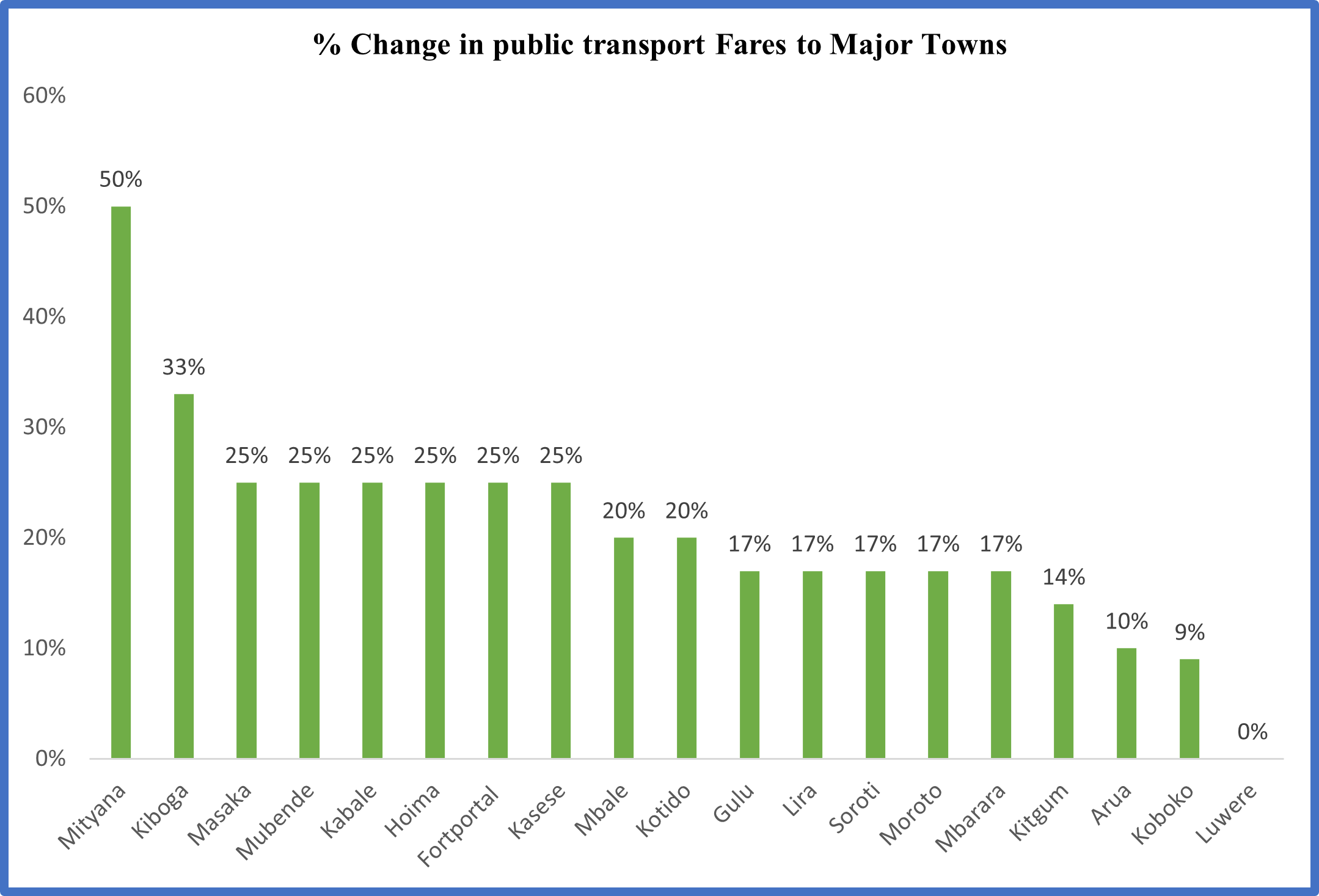
Source: Neofacts 2026
- Mityana: +50% (highest increase)
- Kiboga: +33%
- Masaka, Kasese, Mubende, Kabale, Hoima, Fort Portal: +25%
- Mbale, Kotido: +20%
- Gulu, Lira, Soroti, Moroto, Mbarara: +17%
- Kitgum: +14%
- Arua: +10%
- Koboko: +9%
- Luwero: 0% (remained stable)
These figures represent average fare changes observed across multiple operators on each route during our data collection period.
The pattern is clear: shorter and medium-distance routes operated predominantly by taxis (matatus) recorded the largest increases. Routes served mainly by established bus companies saw more moderate adjustments.
Why Matatu Routes Were Hit Harder Than Bus Routes
Routes to Mityana, Kiboga, Masaka, Mubende, and Luwero are overwhelmingly served by individual matatu operators. These smaller-scale businesses typically:
- Operate with thinner margins per trip
- Purchase fuel in smaller quantities (no bulk discounts)
- Adjust prices more frequently in response to daily cost changes
- Face intense competition that limits their ability to absorb cost increases
In contrast, many long-distance bus companies benefit from:
- Larger fuel purchasing power
- More predictable scheduling and load factors
This structural difference explains why matatu-heavy corridors experienced the steepest fare rises. Passengers on these routes felt the impact most acutely.
Implications for Cost of Living and Daily Life
Higher transport costs directly increase the overall cost of living. For a typical commuter travelling regularly from Mityana or Kiboga to Kampala, a 33–50% fare increase represents a significant reduction in disposable income.
These rises affect:
- Low- and middle-income households who spend a large share of income on transport
- Students and workers who commute daily
- Small traders who travel to sell goods in urban markets
- Families visiting relatives or accessing specialized healthcare in Kampala
When transport becomes more expensive, some people may reduce trips, delay medical care, or limit job searches to areas closer to home. Over time, this can slow economic mobility and widen urban-rural divides.
The increases also contribute to broader inflationary pressures. When workers demand higher wages to cover commuting costs, businesses face rising labour expenses. Goods transported alongside passengers can also see marginal cost increases.
Business Insights: What Stakeholders Should Take Away
For transport operators and matatu owners: Fuel price volatility is now a permanent feature. Successful operators will focus on route optimization, fuel-efficient driving practices, vehicle maintenance to reduce consumption, and exploring collective fuel purchasing arrangements.
For employers and businesses: Staff commuting costs have risen significantly on many routes. Companies may need to review transport allowances, consider shuttle services for key staff, or explore flexible working arrangements to reduce daily travel.
For investors and the transport sector: Routes with more stable bus operations may offer relatively lower risk. There could be opportunities in modernizing fleets with more fuel-efficient vehicles or developing digital booking platforms that improve load factors.
For policymakers and development partners: The data highlights the need for investment in higher-capacity buses on high-demand corridors, or improved road infrastructure to reduce operating costs.
Neofacts’ market research and systematic data collection provide the evidence base needed for these decisions.
Looking Ahead: What to Expect Next
Fuel prices remain sensitive to global oil markets, exchange rates, and domestic supply factors. Unless there is a significant reversal in fuel costs, further modest fare adjustments are likely on many routes in the coming months. The stability on the Luwero route is noteworthy and may reflect different operator dynamics or slightly lower fuel intensity on that corridor. Monitoring these variations month by month remains essential.
Conclusion
Public transport fare increases of up to 50% in June 2026 are a direct consequence of the sharp rise in diesel prices (40.5%) and petrol prices (26.7%). The impact has been uneven matatu-operated routes to Mityana, Kiboga, and similar destinations have borne the brunt, while some longer bus routes adjusted more moderately.
At Neofacts, we believe that accurate, timely market research and robust data collection are essential tools for navigating economic uncertainty. Our public transport and fuel monitors deliver the business insights that individuals, companies, and policymakers need to plan effectively.
If your organisation requires deeper analysis, route-specific data, or custom market research in Uganda, we are ready to help. Reliable data leads to better decisions for businesses and for the millions of Ugandans who rely on affordable public transport every day.
Stay informed with Neofacts. Research. Learn. Inform.