
As a trusted market research company in Uganda and East Africa, Neofacts specialises in data collection and real-time monitoring of key economic indicators. Fuel prices remain one of the most volatile and impactful factors for businesses and households. Our weekly fuel price tracking provides actionable intelligence for stakeholders navigating these shifts.
Global Fuel Price in Mid-2026
Global oil markets have experienced significant volatility in 2026. Brent crude prices spiked sharply earlier in the year due to geopolitical tensions, reaching highs above $100–120 per barrel at peaks, before partially easing. As of mid-June 2026, prices hover around $77–105 per barrel, depending on the benchmark and daily developments, with global average gasoline prices at approximately $1.51 USD per litre.
Key global events driving these changes
US-Iran Conflict and Strait of Hormuz Disruptions: The conflict led to temporary closure or severe restrictions in the Strait of Hormuz (handling ~20% of global oil supply), causing major supply shocks, production outages, and inventory draws. This pushed prices upward dramatically in early 2026. Recent ceasefire announcements and deals have eased some pressures, allowing partial recovery in flows, but lingering uncertainties keep markets volatile.
- OPEC+ Production Dynamics: Voluntary cuts and responses to global events have influenced supply. Non-OPEC+ production growth (e.g., from the US, Brazil) continues to build inventories, exerting downward pressure in calmer periods.
- Demand Factors: Slower economic growth in major economies like China and Europe, alongside efficiency gains, has moderated demand growth to around 1 million barrels per day annually. However, summer travel and other seasonal demands add upward pressure.
- Forecasts for the remainder of 2026 vary, with some analysts projecting averages around $50–80 per barrel as supply surpluses build, though geopolitical risks remain a wildcard.
Uganda Fuel Price Trends. Neofacts Weekly Monitoring Data
In Uganda, retail fuel prices have risen sharply in line with global pressures, compounded by local factors like currency fluctuations, importation costs, and taxation.
Neofacts internal weekly fuel monitoring findings (as a trusted research company focused on precise data collection)
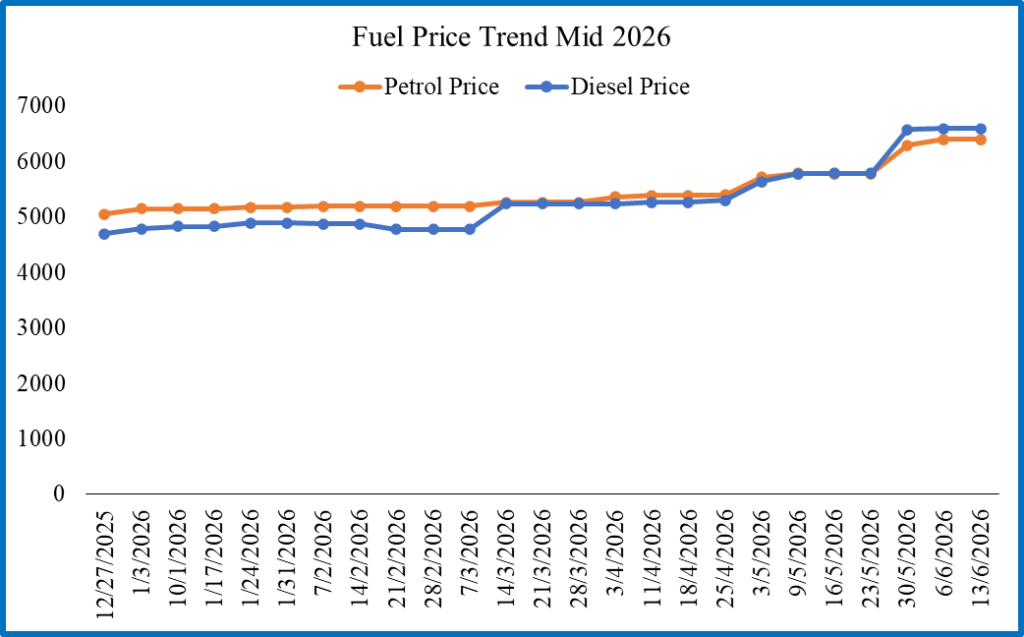
- Diesel: Closed 2025 at 4,698 UGX per liter. As of June 2026, it stands at 6,599 UGX, a 40.5% increase (+1,901 UGX).
- Petrol: Closed 2025 at 5,050 UGX per liter. As of June 2026, it is 6,399 UGX, a 26.7% increase (+1,349 UGX).
Recent pump prices in Kampala (mid-June 2026) align closely, with premium petrol around 6,250–6,499 UGX and diesel near 6,105–6,599 UGX. These increases reflect imported fuel costs tied to global crude benchmarks, plus the Ugandan shilling’s performance against the USD.
New Fuel Tax Hike
As Uganda approaches the new financial year 2026/2027, the government has increased tax on fuel by 200 UGX per liter. Resulting in an excise duty of UGX 1,750 per litre for petrol and UGX 1,430 per litre for diesel. This excise adjustment aims to boost revenue but adds directly to pump prices.
Impacts on Consumers, Businesses, and Government
On Consumers
Higher fuel costs translate to elevated transport fares, food prices (due to higher logistics), and overall living expenses. Households, especially in urban and rural areas reliant on public transport or motorcycles, face reduced disposable income. This could strain budgets amid broader inflationary pressures.
On Businesses
Transport, manufacturing, agriculture, and logistics sectors, heavy diesel users will see rising operational costs. Fleet operators and distributors may pass costs to consumers or absorb margins, potentially slowing growth, investment, and job creation. SMEs with thin margins are particularly vulnerable.
On Government
The tax hike supports revenue targets for infrastructure, services, and debt management. However, if it dampens economic activity or fuels inflation, it could indirectly affect tax collections elsewhere. Policymakers must balance fiscal needs with affordability.
Forward Outlook
Global stabilization depends on resolution of Middle East tensions and supply responses. In Uganda, local prices will continue tracking international crude, exchange rates, and policy decisions. Neofacts recommends businesses hedge where possible, optimize routes/fleets, and monitor weekly data for planning.
As a premier market research company, Neofacts delivers reliable data collection and insights on fuel prices and other indicators to help clients make informed decisions.
Contact us for customized reports, trend analysis, or ongoing monitoring.